When birth control meets the algorithm
Desperate for information, young women are increasingly turning to TikTok for advice on contraceptives they can trust. Often, they find misinformation and ads instead.
Tita Loyek understands better than most people how trends and views drive content — but it didn’t stop her from becoming ensnared in the very system she trusted.
In 2020, the 29-year-old fashion influencer, along with her now-husband packed up their New York City apartment and traveled across the country as digital nomads. They documented their journey on TikTok and picked up social media followers along the way, landing at nearly 200,000.
Family planning videos popped up on her feed as she was beginning to think about starting her own family. In tightly edited clips, content creators seemed to speak directly to Loyek, telling her that years of using birth control may have impacted her ability to have children. She was scared and suspicious.
But the videos offered a solution: Get off hormonal birth control, and start tracking menstrual cycles instead.
She had her Nexplanon implant — a low-dose hormonal birth control option — removed from her arm. Loyek instead started tracking her fertility using an Oura ring and an app called Natural Cycles, a method recommended by other content creators.
The Natural Cycles app tracks a user’s fertility through biometric measurements and a predictive, proprietary algorithm, telling them which days are and aren’t safe for unprotected sex. But within just a few months of use, Loyek received a notification from the app that one of her fertile days had been erroneously labeled as safe for unprotected sex.
Shortly after, she found out she was pregnant.
At first, Loyek was shocked and angry. And even though she and her husband came to embrace the pregnancy, she said she felt "completely blindsided."
“I didn't even know that was like a possibility — that they could renege on those days and just be so wrong,” she said.
In the six years since TikTok reached mass popularity in the United States, young women have used the platform to share medical advice with each other and, often, to offer alternatives to mainstream medical care through techniques like hormone balancing and holistic healthcare. A KFF study found that four in ten women have seen information about birth control on social media, and four in ten have shared it with another person. Fourteen percent of women aged 18 to 25 said that something they saw on social media made them change or consider changing their contraceptive methods.
Content creators emphasized in interviews that their desire to share information about women’s health on social media comes from feeling disenfranchised by doctors. They say their confidence in medical systems is at a low, and many women who follow them agree.
Some say their pain has been ignored, and that their healthcare providers use hormonal birth control as a catch-all for their health concerns. Almost half of young women surveyed by KFF in a 2023 study said they had had a negative experience with a healthcare provider.
But researchers say responses to these concerns, made popular by TikTok’s algorithm, skew towards demonizing hormonal birth control and undermining trust in doctors. Health claims on TikTok are rarely fact-checked. These trends could have unfortunate side effects on women’s health, doctors say, including unplanned pregnancies and future issues with fertility.
According to Lauren Hanafin, a representative from Natural Cycles, just one in 200 women who use Natural Cycles in a year will become pregnant due to an error from the app, like Loyek. When Loyek reported her pregnancy to the company, it offered her a list of resources, including connecting her to Planned Parenthood and the government’s Office on Women’s Health.
Natural Cycles relies on a form of family planning called fertility awareness-based methods, which uses biometric measurements to predict fertility and track ovulation. The app is FDA-approved, requires no hormones, and is favored by the Make America Healthy Again (MAHA) movement, which is skeptical of modern medicine and physician authority. Users input data on their basal body temperature, which is their lowest body temperature in a day and can indicate when a user is ovulating.
'Take this as your sign to not trust your Natural Cycles app.'

The app uses an algorithm to give users a calendar of days when they can have sex with a very low risk of pregnancy. Body temperature can be reported through tech wearables like the Apple Watch and Oura Ring.
With perfect use, the American College of Obstetricians and Gynecologists says that this type of birth control is 95 percent effective for the first year, and 76 percent effective with typical use, which accounts for user error and improper measurements. Natural Cycles reports even higher effectiveness.

Does anyone else feel this way?
In TikTok videos, women blame hormonal birth control for vitamin deficiencies, depression and mood instability, low libido, and physical pain. In a popular genre of videos, they unfurl the side-effect pamphlet from their birth control pills and use it as a blanket. Others edit together clips of them sobbing, with captions like “me on birth control.”
Some go further.
In one TikTok video, a creator with the handle @back_inbalance claimed that birth control depleted vitamins, causing depression in young women. In another, @stirling_cooper spoke directly to a camera over ominous music, claiming that birth control was poisoning the minds and bodies of women. “Birth control is one of the most damaging things you can put in your body,” said another creator, with the handle @theworkoutwitch.
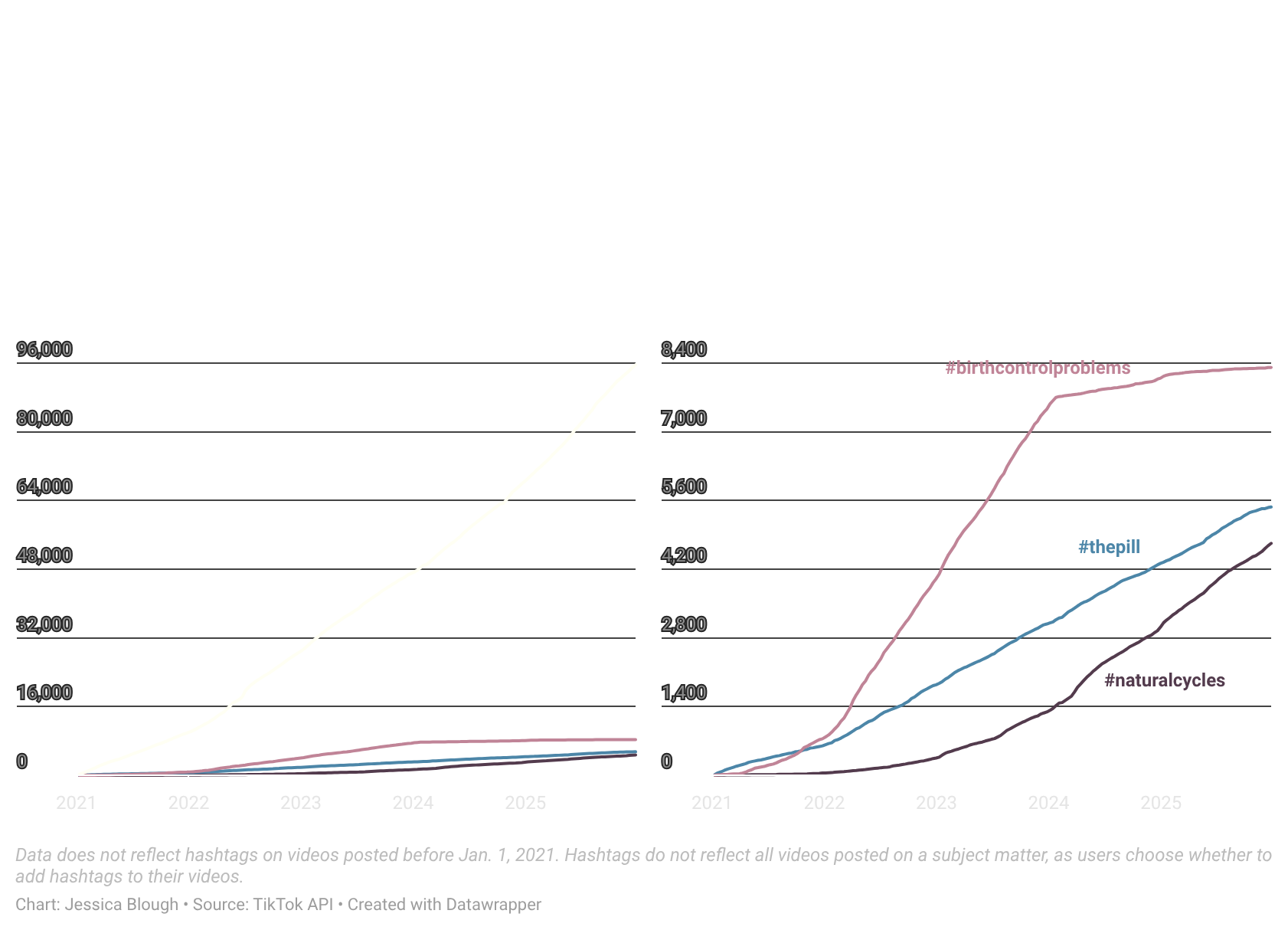
On social media, women attribute a host of negative side effects or medical issues to their hormonal birth control, often using misreadings of medical research to back up their points. Here's what that looks like.
On social media, personal reports are rarely checked for their veracity or created by medical professionals. Social media videos tend to emphasize the risks or unlikely side effects of contraceptives that involve hormones, researcher Emily Pfender said, while glossing over the risks of other, nonhormonal methods.
Narratives like these can get traction on social media. Some unsupported claims suggest birth control can decrease fertility. Others have claimed that hormonal birth control can make women more attracted to other women than men, which was spread by Elon Musk.
Pfender, a postdoctoral researcher at the University of Pennsylvania, started studying social media trends in women’s health in 2019. She was one of the first. She says sharing health information, which often comes in the form of first-person accounts, has been part of the social media landscape since before TikTok became popular.
“This content has the potential to dissuade women from using hormonal contraceptives, which have a lot of value for pregnancy prevention, as well as health issues and medical issues,” she said.
Unlike other social media sites, TikTok doesn’t have a system of protections that prioritize doctors. TikTok did not respond to a request for comment.
“Women want answers,” Pfender said. “A lot of women don't have answers, and a lot of women deal with not being believed. They deal with a lot of medical gaslighting and women's pain not taken seriously.”
An early contraceptive-related TikTok trend involved women filming themselves during intrauterine device (IUD) insertions, recording the excruciatingly painful cramping they experienced without any anesthesia. According to the American College of Obstetricians and Gynecologists (ACOG), IUD insertion is “often painful or uncomfortable.”
ACOG recommended further research into addressing this pain for the comfort of patients.
That fear of pain and distrust in medicine can be wielded on TikTok to increase views, Pfender said.
“The videos where women were talking about being medically disenfranchised, they got significantly more engagement,” she added.
Fear and the rise of the 'natural' right
In rural Montana, Branna Grace Reed’s life looks different than Loyek’s. She feeds chickens, bakes cookies, and breastfeeds her young daughter in videos she posts on TikTok. On a video call, she’s forthcoming and warm, her voice retaining its deep Southern accent.
Reed was 16 years old when she was put on the pill.
As a teenager in Tennessee, she said she felt like the birth control pill was a catch-all solution to breakouts and irregular periods, and she had little choice in the matter.
She stopped hormonal birth control in her early twenties, eventually switching to Natural Cycles paired with her Oura Ring. But she wasn’t the most diligent user of the app, leading to her pregnancy.
Now 26, Reed said she’s gone through periods of skepticism about artificial dyes, antibiotics, chemicals, and toxins that have caused her extreme anxiety. TikTok stroked these fears, introducing her to unproven medical advice and conspiracy theories, including those related to hormonal birth control.
“I went down a rabbit hole of the nontoxic, holistic world,” Reed said. “It is a dark, dark hole.”
After intervention from her family, she’s trying to seek more balance and hold doubt for what she sees online.
Her six-month-old daughter coos quietly next to her, then more insistently until Reed picks her up. Reed wears a gold wedding ring and matching Oura Ring on the fingers of her left hand.
“You can get so much [from social media], but I had to be mindful of what was fear mongering versus trying to educate people,” Reed said. “If I feel like I'm getting scared from content that I'm consuming or information that is being thrown at me, I have to take a step back.”
Fear is often part of the formula used by those campaigning against hormonal birth control, including leaders of the U.S. far-right and the Make America Healthy Again movement. In a TikTok video with 4.3 million views, Elon Musk claims on the Tucker Carlson Network that hormonal birth control causes depression, increases risk of suicide, and makes women choose partners that they wouldn’t select if they were not on the pill. (Multiple doctors said that these claims are false or misleading.)
Federal cuts to Medicaid and Title X are likely to make it more difficult for people to access contraceptives and pay for them, and millions of Americans lost abortion access after the Supreme Court’s Dobbs v. Jackson Women's Health Organization decision in 2022, which overturned Roe v. Wade.
'A lot of women are unaware that hormonal birth control causes depression and dramatically increases risk of suicide and changes their preferences on who they want to marry or have kids with. It changes their personality.'
Media researchers are careful to separate their work from any political motivations or calculations. But the need for reliable information in an ecosystem flooded with misinformation comes up when they’re doing research on social media and conducting interviews with content creators, several researchers said.
That need is accentuated, Pfender said, by how much content on social media about contraceptives and women’s health is tied to advertising a product. For example, in videos warning women that birth control might disrupt their hormones and make them vulnerable to infertility, content creators often direct women back to fitness and health packages or subscriptions, or an Amazon storefront full of supplements.
“They use that and repurpose it to basically sell women products and services that they don't really need, that are not evidence based,” Pfender said.
“People will throw words around, like hormone balancing or endocrine disruptors or infertility,” Reed said. “If someone's throwing constant products at you, I'm like, well, you're just trying to make money off these people trying to figure out their health, especially women.”
Natural Cycles, the app that Reed and Loyek were using when they got pregnant, runs advertisements on social media and pays influencers to create sponsored posts. It charges a monthly subscription fee for its users, starting at $21.99. Users can pair the app with their Apple Watch — starting at $249 — or Oura Ring — starting at $349 plus a subscription. The app’s algorithm converts that temperature and sleep data into insights about fertility.
Hanafin, from Natural Cycles, denied that the company has purposely profited off the country’s rightward shift.
“Those are conversations that we want, quite frankly, no part of,” she said.
But the selling point for young women can be the personalization of stories about birth control on social media. Erin Ash, a professor in health communications at Clemson University, reviewed 1,600 videos of women talking about contraceptives on social media between 2021 and 2023, each with over 100,000 views. Like Loyek’s video, the majority were based on personal anecdotes that communicated a specific experience.
While Ash led the video analysis portion of the project, her colleague Ashley McKenzie, from the same department, conducted a series of interviews with influencers on why they post information related to contraceptives on social media. The results surprised her: Influencers’ primary motive for sharing their stories about birth control on social media wasn’t profit or engagement. Instead, the 15 women she talked to expressed a sense of care for their audience and a desire to help other women, even when the information they were sharing was not factually accurate.
But when this desire to share information comes in the form of medical skepticism, it can have real, physical effects. Researchers at Sheffield University led by Rebecca Webster found that young women who have doubts about the pill, were exposed to counter narratives about modern medicine, or are distrustful of the healthcare system report worse side effects from being on hormonal birth control.
The consequences can be dangerous. Webster gave an example of the rollout of the HPV vaccine rollout in 2013 in Japan: Shortly after it became available, unfounded reports of side effects of the vaccine on girls circulated through the media, gaining traction until Japan halted the vaccination program. The Japanese government didn’t recommend the vaccine, which can help prevent cervical cancer, until 2021.
A growing countermovement
For many young women, the sense of who to trust is slipping.
Doctors appointments are harder to get. The costs of medical care and insurance are rising. The CDC eliminated the segment of its reproductive health unit that handles best practices around contraceptives. Large segments of the country have no gynecologists.
But TikTok is free, easy to access, and already where so many young people are.
Some content creators are recognizing the need for different stories on social media about birth control. They defend their birth control in impassioned videos, warning their followers to be skeptical of ads and scare tactics on social media. Those videos express gratitude, and even love, for hormonal birth control.
'There's a lot of all natural things that I do in my life, and I don't feel like birth control is something that's gonna ruin my health.'
Loyek is still posting on TikTok, sharing glimpses of days in her life with her 190,000 followers. She’s emerged skeptical about the anti-hormone messaging on birth control.
Instead of hunting for sample sales, she’s pivoted to postpartum videos. After a miscarriage, which she documented on TikTok, she got pregnant again and had her daughter at the beginning of April. Now, she said she’ll get back on birth control — likely a hormonal method.
“Definitely not Natural Cycles,” she said.
Meanwhile, researchers and doctors are trying to keep pace. McKenzie and Ash, the researchers at Clemson University, are already thinking about their next research project: a toolkit to help content creators spot misinformation on social media and spread more health-informed information.
Dr. Jennifer Lincoln is speaking straight to the source. An OBGYN in the Portland, Oregon, area, Lincoln has built an audience of 2.8 million TikTok followers who come to her with questions about birth control, hormones, labor, and abortion. Speaking directly to the camera in nearly all her videos, she is often visibly angered by the quantity of misinformation that she encounters online, then tries to counteract.
Lincoln started making social media videos as a doctor in 2018, before TikTok became popular in the U.S. The platform is one of the worst for spreading reliable medical information, she said. And she worries about the consequences for those who fail to recognize bad information.
“I worry so much about the person who is watching this video who now isn’t going to seek care or try something that could literally save them from getting cancer of the uterus or being suicidal during their period,” Lincoln said.
“I hate the idea that there are influencers out there who have no skin in the game, who will never be held accountable for the harm that they’re causing to some of these people.”•
Social media videos for a social media story
These videos explain the contents of this story and demystify a few common narratives about birth control on social media. Click on each one to view in full screen.
Learn more about this story
Hear from OBGYNs about common birth control myths